How Many Tourists Visit Berlin Each Year?
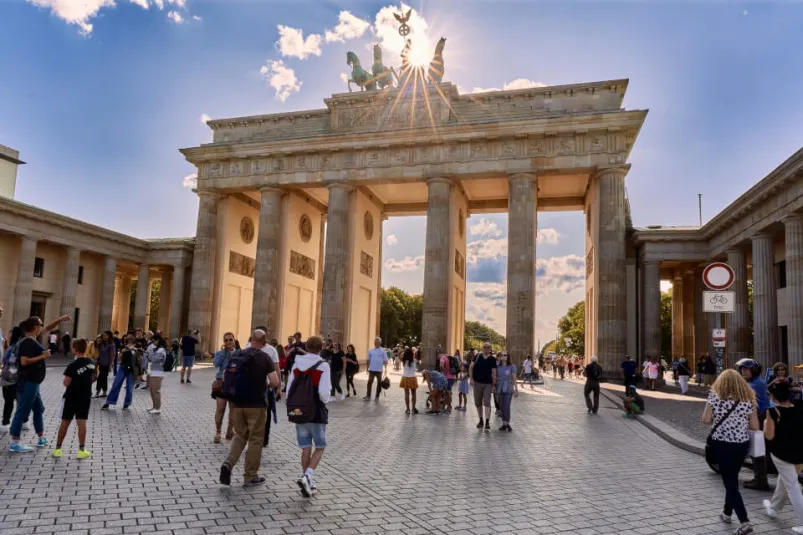
Berlin remains one of Europe’s most fascinating cities. Year after year, the German capital attracts millions of people who want to experience the city’s culture, history, and unique lifestyle. But how exactly is this appeal reflected in the data?
This article examines current visitor numbers, historical trends, the importance of tourism for the local economy, and comparisons within a national and international context.
Current Data and Trends Over the Years
Following a historic high in 2019 (with approximately 14 million visitors and 34.1 million overnight stays) and the subsequent slump caused by the global pandemic, Berlin’s tourism sector has stabilized at a level just below its pre-crisis all-time high.
The official tourism statistics from the Berlin-Brandenburg Statistical Office paint the following picture:
- Visitor arrivals: In 2024, Berlin recorded approximately 12.7 million visitors; in 2025, the figure was 12.4 million visitors.
- Overnight stays: The number of booked overnight stays stood at 30.6 million in 2024 and stabilized at 29.4 million overnight stays in 2025.
The share of international visitors has recently remained steady at around 41%. The three most important countries of origin in the international segment have traditionally been the United States, the United Kingdom, and the Netherlands. However, domestic tourism accounts for nearly 60% of the market.
Forecasts for the Future
Experts at the Senate Department for Economic Affairs are increasingly focusing on qualitative and city-friendly development rather than purely record-breaking growth. Forecasts predict moderate but stable consolidation through the end of the 2020s. Future growth will be driven in particular by a noticeable recovery in the Asian market (especially from China and India) as well as by the continuously growing MICE sector (Meetings, Incentives, Conventions, Exhibitions).
Key Tourism Statistics at a Glance
Length of Stay and Spending Habits:
- Average length of stay: A tourist stays an average of 2.4 days at a traditional Berlin lodging facility. When staying in privately arranged vacation rentals (such as Airbnb), the length of stay is significantly higher, at around 4.0 days.
- Tourist spending: Total spending by all visitors to Berlin is estimated at around 15.7 billion euros per year. An overnight guest spends significantly more on average than a day-trip tourist, with the main areas of spending being lodging (approx. 34%), the hospitality industry (approx. 17%), and shopping or retail (approx. 19%).
Economic Driver for Berlin
Tourism is one of the most important drivers of Berlin’s economy. The value added by tourism alone in the capital amounts to approximately 8.7 billion euros.
- Share of GDP: Tourism contributes (directly and indirectly) about 6.6% to the total economic output (GDP) of the State of Berlin. In terms of its importance to the city, the industry even surpasses traditional sectors such as construction.
- Jobs: Nearly 11% of all employed people in Berlin (approximately 227,000 jobs) depend directly or indirectly on tourism and the convention industry.
Comparison with the Population
With a population of around 3.87 million people, Berlin welcomes over 12 million tourists annually. This means that, purely mathematically, about three times as many tourists visit the city each year as the number of people who live there permanently. There are just under 8 overnight stays per resident annually.
Berlin’s Most Visited Attractions
The list of top attractions is led by historical monuments and cultural institutions. Estimates and surveys by visitBerlin and the respective operators show the following annual frontrunners:
- The Brandenburg Gate & Pariser Platz: As a national symbol of unity, it is the undisputed number one attraction (free admission, estimated at over 12 million visitors in the surrounding area).
- The Reichstag Building (Bundestag): With its accessible glass dome, it attracts around 3 million visitors annually (registration required).
- Berlin’s Museum Island: This UNESCO World Heritage Site (including the Pergamon Museum, Neues Museum, etc.) attracts a combined total of approximately 2.5 to 3 million visitors, depending on renovation phases.
- The Berlin TV Tower at Alexanderplatz: Germany’s tallest structure, with approximately 1.2 million visitors per year.
- The Berlin Wall Memorial (Bernauer Straße) & Checkpoint Charlie: Historic sites of the city’s division that, combined, also attract millions of people.
Berlin in National and International Comparison
To put the scale of Berlin’s tourist flows into perspective, it is worth taking a look at the rankings both in Germany and abroad.
The 5 Most-Visited Cities in Germany
(Measured by the annual number of overnight stays in lodging facilities)
| Rank | City | Overnight stays per year (rounded) |
|---|---|---|
| 1 | Berlin | 29.4 – 30.6 million |
| 2 | Munich | approx. 18.0 – 19.0 million |
| 3 | Hamburg | approx. 15.0 – 16.0 million |
| 4 | Frankfurt am Main | approx. 10.0 million |
| 5 | Cologne | approx. 6.5 – 7.0 million |
The 10 Most-Visited Cities in Europe
(Based on international overnight arrivals according to current index data from Euromonitor and StatRanker)
| Rank | City | Country | International Overnight Arrivals per Year (in millions) |
|---|---|---|---|
| 1 | London | United Kingdom | 22.7 |
| 2 | Istanbul | Turkey | 19.7 |
| 3 | Antalya | Turkey | 18.6 |
| 4 | Paris | France | 18.3 |
| 5 | Rome | Italy | 15.5 |
| 6 | Barcelona | Spain | 15.1 |
| 7 | Amsterdam | Netherlands | 14.7 |
| 8 | Madrid | Spain | 14.3 |
| 9 | Vienna | Austria | 13.5 |
| 10 | Milan | Italy | 11.1 |
Note on methodology: While German statistics primarily track total overnight stays (domestic and international), continental city rankings are usually based solely on international arrivals (guests staying at least one night). With approximately 10.7 million international arrivals, Berlin ranks just behind Milan in the global index and thus holds a respectable 11th place in Europe—ahead of other historic cultural capitals such as Prague and Florence.
Why does Berlin attract so many tourists?
Berlin’s enduring popularity stems from a combination of various factors that are rarely found together anywhere else in the world:
- Unique modern history: No other European metropolis played such a central and radical role in world history during the 20th century. The traces of World War II, the division caused by the Wall, and the Cold War can be authentically experienced in the cityscape (East Side Gallery, Checkpoint Charlie).
- Cultural diversity and subculture: With three active opera houses, over 170 museums, and a world-famous club and electronic music scene, Berlin boasts an immense cultural diversity. The city is considered a melting pot for creative people from all over the world.
- International Event Hub: Major events such as the Berlin Marathon, the Lollapalooza Festival, the Berlinale, and the numerous street festivals (such as the Carnival of Cultures) specifically attract audiences numbering in the millions.
- Relatively Moderate Prices: Compared directly to other Western metropolises such as London, Paris, or New York, Berlin continues to offer an attractive value for money when it comes to dining, culture, and hotel accommodations.
- Status as a conference city: Berlin ranks among the world’s top destinations for scientific conferences, association meetings, and trade shows (e.g., ITB, IFA), which consistently guarantees a high proportion of affluent business travelers.
Berlin impressively demonstrates that it maintains its enormous appeal even in a changing global tourism market. The city thrives on its wealth of contrasts—between its turbulent history and vibrant modernity, between international business and subcultural niches. With over 12 million visitors annually, the city on the Spree remains an undisputed economic engine for the region and one of Europe’s most dynamic destinations. The challenge ahead will be to continue successfully striking a balance between economic growth and the quality of life for Berliners.

Berlin Poche
Editorial Team
Always looking for new addresses, we like to share our discoveries and make you discover the best places in Berlin.